Game Review: Honkai Star Rail
 |
| Honkai: Star Rail Logo (Wikipedia, 2026) |
Honkai: Star Rail (崩坏: 星穹铁道) is a turn based RPG developed by miHoYo. The game was released on April 26, 2023, and continues to maintain a strong player base. Since its launch, the game has won multiple awards, with one of the most notable being Best Mobile Game at The Game Awards 2023, and the most recent being Mobile Game (Players’ Voice) at the Ultra Game Awards 2025 (Wikipedia, 2026).
I started playing this game in 2024 and still play actively. The game stands out to me because of its visuals and well-written story. Each character has its own unique design and the story keeps progressing, which keeps you engaged beyond the core gameplay.
Before going deeper into my experience, let me first explain how the gameplay works.
⋆ ˚。⋆୨୧⋆。˚⋆
Gameplay
Honkai: Star Rail combines turn based combat with exploration and story driven content. You progress by moving through different worlds, interacting with characters, and completing missions that expand the main storyline. Each area includes side quests, hidden chests, and small puzzles that reward you for exploring carefully.
The story is a major part of the experience. New updates introduce additional story quests and regions, such as Amphoreus, which expand the narrative and add new characters. These quests often include cutscenes, dialogue choices, and combat encounters, which keep the gameplay varied.
Combat remains the core system. You build a team of up to four characters and take turns using basic attacks, skills, and ultimate abilities. Strategy depends on how you assemble your team and use each character’s abilities during combat. When building characters and forming teams, you need to consider several key elements such as types, paths, traces, relics, and light cones.
For players who want a challenge, the game also offers end game content. These modes require stronger characters and better team composition. In many cases, you need at least two fully built teams to complete higher level stages.
The game also features regular events that add variety to the experience. These events often introduce new mini games, limited time story content, and unique rewards. Some events focus on combat challenges, while others offer more relaxed gameplay such as puzzles or exploration tasks. This keeps the game fresh and gives you reasons to return even after finishing the main content.

1. Types
Honkai: Star Rail features seven Types: Physical, Fire, Ice, Lightning, Wind, Quantum, and Imaginary. Each character is assigned one of these Types, and their attacks deal the corresponding elemental damage (Honkai: Star Rail Wiki, n.d.).
Enemies typically have between two and four elemental weaknesses. When you attack using a Type they are weak against, their Toughness gauge decreases. Once this gauge is fully depleted, the enemy enters a Weakness Break state. This triggers additional Break damage, applies a debuff linked to the triggering element, and delays the enemy’s next action. The enemy remains in this weakened state until their turn, during which they also take increased damage (Honkai: Star Rail Wiki, n.d.).
 |
| All types (Brighella, 2022) |
2. Paths
Paths can be understood as forms of imaginary energy that represent broad philosophical ideas. When an Aeon comes into existence, a corresponding Path is formed, and that Aeon gains control over it. The Aeon can then direct this energy according to its own purpose (Honkai: Star Rail Wiki, n.d.).
A person aligns with a Path when their beliefs and intentions match its underlying idea. If this alignment is strong, they can draw power from it and become a Pathstrider. The Path they follow is not fixed, it can shift as their views and values change over time (Honkai: Star Rail Wiki, n.d.).
Some individuals go further and become Emanators. These are people who receive direct permission from an Aeon to access greater power from a specific Path. They are not controlled by the Aeon, but others often see them as representatives of that Aeon’s will (Honkai: Star Rail Wiki, n.d.).
3. Traces
Traces are each character’s skill tree. Through the Traces system, you can upgrade abilities, unlock bonus abilities, and improve base stats (Honkai: Star Rail Wiki, n.d.).
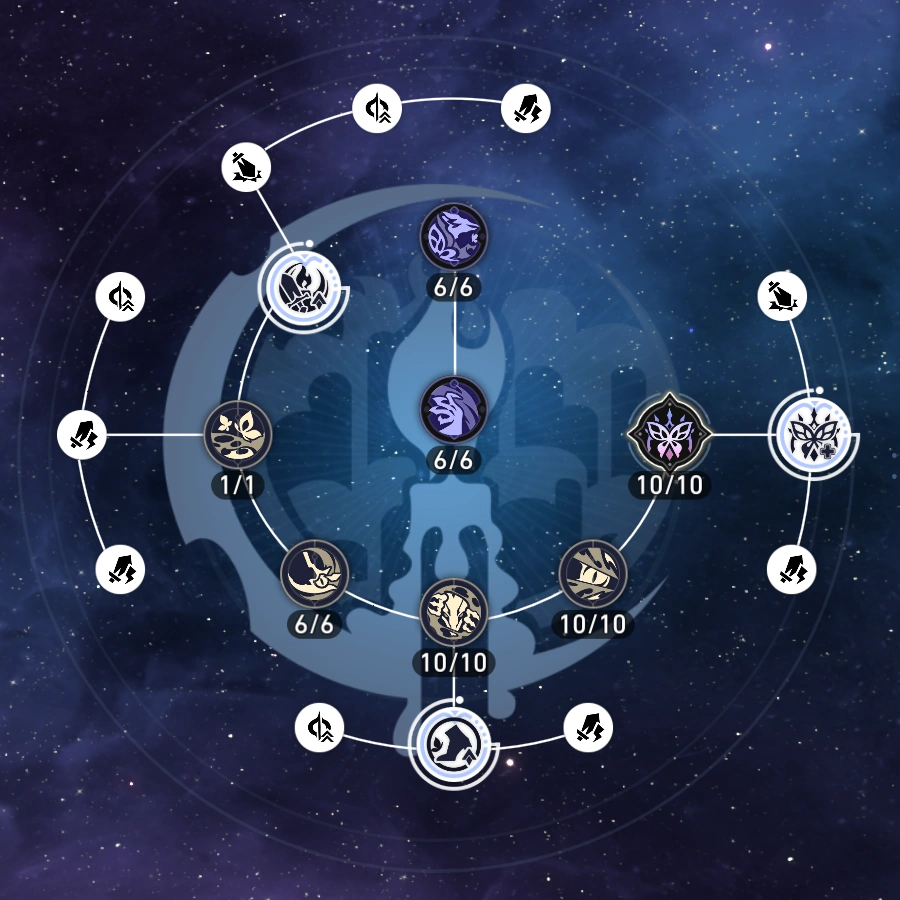 |
| Trace Table Castorice (Honkai: Star Rail Wiki, n.d.) |
4. Relics
Relics are equipment pieces that you can assign to characters to improve their stats. When you equip matching pieces from the same set, you gain additional set bonuses. You can also upgrade Relics using EXP materials to increase their effectiveness (Honkai: Star Rail Wiki, n.d.).
Each Relic has one main stat and, depending on its rarity, up to four sub stats. These values have a strong impact on performance in combat. The main stat is fixed based on the Relic type, while the sub stats are generated randomly (Honkai: Star Rail Wiki, n.d.).

5. Light Cones
Light Cones are equipment that increase a character’s base HP, ATK, and DEF, and provide a passive ability when the Path matches the character (Honkai: Star Rail Wiki, n.d.). You can think of them as the game’s version of weapons. Some Light Cones are also designed for specific characters and work best when paired with them.
Highlights and Drawbacks
Unique Character Design
One of the things I enjoy most about the game is its character design. It follows the familiar style of miHoYo, with a lot of attention given to outfits, colors, and small details that make each character stand out. You can tell that every design has a clear theme behind it, which makes the characters feel distinct from one another.
What makes it even better is how these designs are supported by the story. Each character has their own background, personality, and role in the world, and the voice acting adds another layer that makes them feel more real. Because of this, it becomes easy to grow attached to them as you progress through the game.
For me, I found myself especially drawn to Robin, Castorice, Cyrene, and Phainon. Whether it is their design, personality, or their role in the story, they each left a strong impression on me and made the experience more enjoyable.
 |
| From left to right: Robin, Castorice, Cyrene |
Story Quests & Cutscenes
The story follows you as the Trailblazer, traveling with the Nameless along the Path of Trailblaze. Together, you explore different worlds, meet new characters, and build connections across planets. Each location has its own setting, conflicts, and people, which keeps the journey from feeling repetitive.
What stood out to me over time is how much the writing has improved. In the beginning, I did not feel fully engaged and even stopped playing for a while. After coming back and giving it another chance, I noticed a clear difference. The newer story arcs feel more focused, and the characters are given more depth, which made me more invested in what was happening.
The cutscenes also play a big role in this experience. At times, it feels like you are watching a movie rather than playing a game. The visuals are polished, and the camera work makes important moments stand out. On top of that, the soundtracks used in these scenes match the mood well and help build tension or emotion when needed. This combination of visuals, music, and storytelling makes key moments more memorable and adds weight to the overall narrative.
Music (HOYOMiX)
The music of this game plays a major role in shaping the experience, and it is one of the reasons I keep coming back to the game.
The soundtracks are produced by HOYOMiX, the in house music team behind many of miHoYo’s games (Honkai: Star Rail Wiki, n.d.). They are known for creating a wide range of styles, from orchestral pieces to electronic and vocal tracks, depending on the setting and mood of each scene. Each region and major moment in the story has its own distinct sound, which helps make every part of the game feel different.
What I like most is how well the music matches what is happening on screen. Calm exploration themes, emotional story tracks, and intense battle music all feel carefully placed. Some songs stay in your head even after you stop playing, which says a lot about their quality.
Let’s listen to some of the tracks together!
(Honkai: Star Rail, 2024)
Others
Some other features I enjoy in the game include:
- The skip button. After many requests from players, the developers finally added this option in a recent update. I mostly use it for side quests and event content that I do not find as engaging, which helps me focus on the parts I care about.
- Target build system. The game includes a feature where you can choose a target build, and it will suggest suitable Relics and the materials needed to upgrade your character. This makes character progression clearer and saves time when planning builds.
- Two times speed option. You can enable a 2x speed mode during combat to make battles faster. This is useful when farming or repeating stages, as it reduces waiting time while keeping the gameplay smooth.
- The auto play system. This allows the game to handle combat for you, which is useful when you are farming materials or repeating stages.
There are also some drawbacks that stand out:
- Progression depends heavily on daily activity. To earn premium currency, you need to complete daily tasks regularly, which creates pressure to log in and complete the daily tasks every day. The alternative is spending money (that I don't have ;-;).
- The gacha system is unpredictable. Characters and Light Cones are not guaranteed, and losing a 50/50 can feel frustrating, especially after saving resources for a long time.
- Limited character movement in regular scenes. Outside of major cutscenes, animations can feel repetitive, which reduces immersion during dialogue or exploration.
- Inconsistent character design. Some semi important characters have simple designs that make them blend in with standard NPCs, which can make their role in the story feel less significant.
Final Rating
I would give this game a solid 8.5 out of 10. I really enjoy the story, the characters, and especially the music, but there are still areas where the game can improve.
Even with these issues, I keep coming back to it. The game gives me something to look forward to, whether it is a new update, a new character, or the continuation of the story. It has become part of my routine, and I can see the effort the developers put into improving it over time.
If you are looking for a game with unique character design, easy to learn gameplay, and an engaging story, you can download it from the Official Website or through the Google Play or App Store!
Now is a great time to start playing the game as it is the game's 3rd year anniversary, which means many generous rewards for its players!
Let me know down in the comments if you play the game so we can add each other!
 |
| (Honkai: Star Rail Wiki, n.d.) |
Reference List
Brighella. (2022, June 14). Honkai: Star Rail beginner guide. HoYoLAB. https://www.hoyolab.com/article/5396826
Honkai: Star Rail. (2024, May 9). Honkai: Star Rail trailer [Video]. YouTube. https://youtu.be/xFHNWJVsjmY?si=afJO7NyEaLX4coZh
Honkai: Star Rail. (2025, May 22). Honkai: Star Rail trailer [Video]. YouTube. https://youtu.be/loWA5o1RdTY?si=LRSquffLQ3XbvI12
Honkai: Star Rail Wiki. (n.d.). Honkai: Star Rail Wiki. Fandom. https://honkai-star-rail.fandom.com/wiki/Honkai:_Star_Rail_Wiki
Honkai: Star Rail Wiki. (n.d.). HOYO-MiX. Fandom. https://honkai-star-rail.fandom.com/wiki/HOYO-MiX
Honkai: Star Rail Wiki. (n.d.). Light Cone. Fandom. https://honkai-star-rail.fandom.com/wiki/Light_Cone
Honkai: Star Rail Wiki. (n.d.). Path. Fandom. https://honkai-star-rail.fandom.com/wiki/Path
Honkai: Star Rail Wiki. (n.d.). Pom-Pom Gallery. Fandom. https://honkai-star-rail.fandom.com/wiki/Pom-Pom_Gallery
Honkai: Star Rail Wiki. (n.d.). Relic. Fandom. https://honkai-star-rail.fandom.com/wiki/Relic
Honkai: Star Rail Wiki. (n.d.). Trace. Fandom. https://honkai-star-rail.fandom.com/wiki/Trace
Honkai: Star Rail Wiki. (n.d.). Type. Fandom. https://honkai-star-rail.fandom.com/wiki/Type
Wikipedia. (2026, April 28). Honkai: Star Rail. https://en.wikipedia.org/wiki/Honkai:_Star_Rail
Zenki Ch. (2025, November 6). Honkai: Star Rail gameplay [Video]. YouTube. https://youtu.be/3i1__Q1j7LE?si=JGL7Qf4jcKQ4b-yK


